

YY-IC: Artificial Intelligence, Rare Earths, and Semiconductors – Can China Usher in a 'New National Fortune in 2026

AI is Driving Explosive Growth in Global Computing and Energy Demand
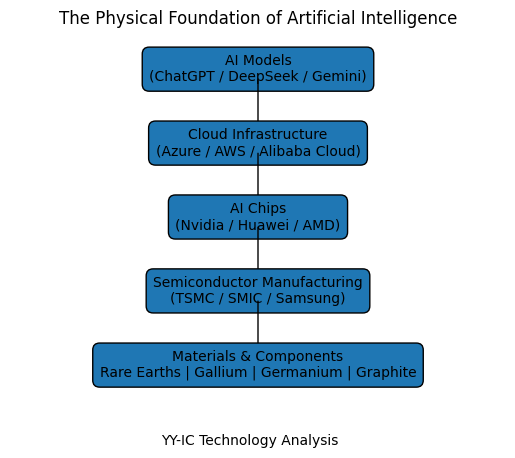
The Physical Foundation of Artificial Intelligence
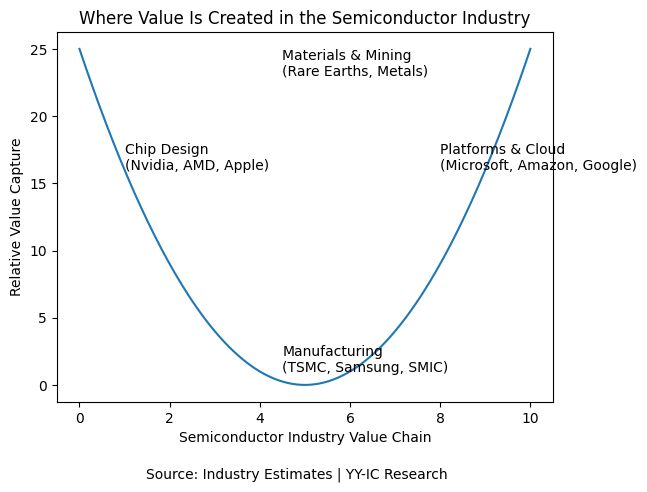
Where Value Is Created in the Semiconductor Industry
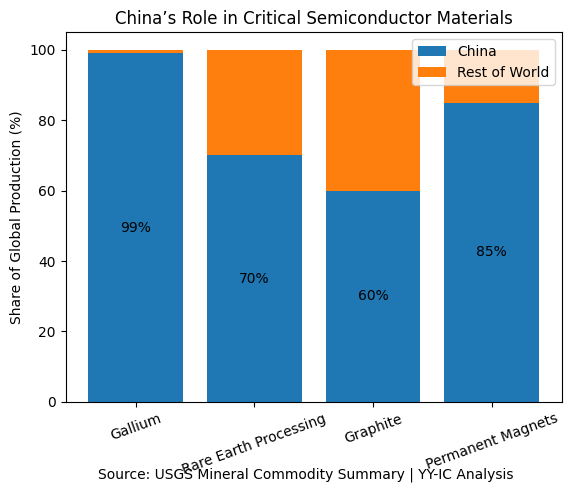
China’s Role in Critical Semiconductor Materials
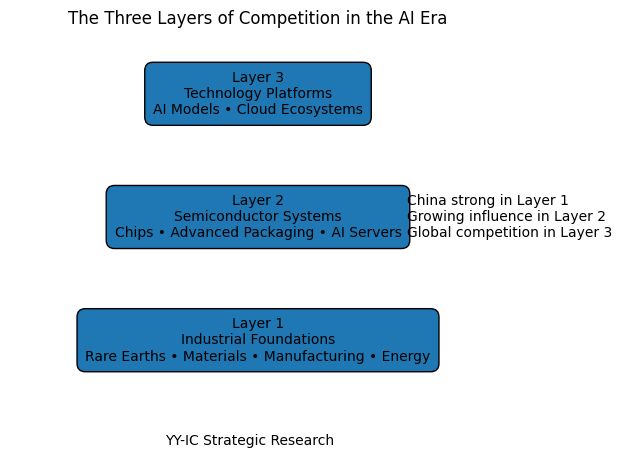
The Three Layers of Competition in the AI Era
As AI reshapes global technology supply chains, China’s strengths in rare earths, manufacturing and semiconductors may create a new strategic window.
SINGAPORE, March 10, 2026 /EINPresswire.com/ -- YY-IC today released a new industry analysis examining the growing role of artificial intelligence, rare earth materials and semiconductor supply chains in shaping China’s technology landscape toward 2026. The report discusses how rapid expansion in AI computing demand is increasing the strategic importance of materials, semiconductor infrastructure and large-scale industrial ecosystems.
The analysis addresses ongoing global discussions around semiconductor supply chains, AI infrastructure and critical materials and examines how these factors may influence China’s position in the evolving technology landscape.
Industry Context
A YY-IC research analyst commented:
“Artificial intelligence is increasingly reshaping the relationship between software innovation and physical industrial capacity. As AI adoption expands globally, materials, semiconductor manufacturing and integrated industrial ecosystems are becoming more strategically significant.”
Over the past two years, a new narrative has begun circulating in policy discussions, technology forums and parts of the financial press: China may be approaching a new strategic cycle.
The logic behind this argument is relatively simple. Artificial intelligence requires chips. Chips require materials. And many of the critical materials and supply-chain choke points sit in China. Rare earths, gallium, germanium, graphite, permanent magnets, mature-node fabrication, advanced packaging capabilities—combined with the world’s largest manufacturing base and the largest industrial application market—have led some observers to conclude that China may be entering a new phase of strategic ascent.
This view is not entirely unfounded. In 2025 global semiconductor sales reached roughly $795.6 billion, representing a 26.2% increase year-on-year, with data centers and AI systems among the strongest drivers of demand. China’s semiconductor market itself grew by 17.9%. In other words, AI is no longer an abstract technological concept. It is actively redefining the value of chips, materials and industrial capability.
Yet the phrase “new national fortune” is dangerous once spoken aloud. It easily turns analysis into emotion. The term suggests not merely industrial opportunity but something closer to historical inevitability. The problem is that history rarely rewards countries simply because they hold strong cards. History rewards countries that can turn those cards into systems.
So the real question is not whether China possesses rare earths, markets or engineers.
The real question is this:
In a world where AI is reshaping global value chains, can China transform its advantages in materials and manufacturing into advantages in platforms and pricing power?
The Last Thirty Years Rewarded Knowledge
For most of the past three decades, the most profitable segments of the global economy were rarely located in factories or mines. Instead, they existed at the two ends of the knowledge economy: research and development on one side, and platforms, brands and financial systems on the other.
Whoever controlled operating systems, semiconductor design tools, cloud infrastructure or high-end GPU architectures tended to sit closest to the center of profits.
Today’s most influential technology companies illustrate this structure clearly. Nvidia designs advanced AI chips but does not fabricate them. Microsoft dominates enterprise software and cloud infrastructure. ASML produces the lithography machines that enable cutting-edge semiconductor fabrication. TSMC manufactures the world’s most advanced chips.
All of them occupy the higher positions of the modern technological value chain.
Manufacturing and resource extraction, though essential, often capture a smaller share of the total value created.
China’s rise over the past two decades largely occurred within the middle layers of this system. The country developed the most comprehensive manufacturing ecosystem on earth, producing everything from smartphones and batteries to telecommunications infrastructure and electric vehicles. Yet even as China’s industrial capability expanded, the most profitable parts of the digital economy often remained elsewhere—in software platforms, intellectual property and global technology ecosystems.
Artificial intelligence, however, may be altering one of the key assumptions behind this distribution of value.
AI Is Changing an Old Assumption
For decades the global economy treated knowledge as the primary source of scarcity and value. Software, algorithms and intellectual property generated enormous returns because they were difficult to replicate.
But AI may be changing that assumption.
Routine knowledge work is becoming cheaper and more easily reproduced by machines. At the same time, the physical constraints underlying digital infrastructure are becoming more visible.
AI is not merely software. It is an industrial system.
The International Energy Agency’s 2025 report highlights a striking trend. Global data centers consumed roughly 415 terawatt-hours of electricity in 2024. By 2030, baseline projections suggest consumption could reach 945 terawatt-hours. The United States and China together are expected to account for nearly 80 percent of the growth.
The implication is simple but profound: the stronger AI becomes, the less it resembles pure software and the more it resembles an industrial machine—one that consumes electricity, copper, materials and equipment on a massive scale.
And this places China in a uniquely interesting position.
China’s Position in the AI Era
On the one hand, China is not the uncontested leader in advanced AI chips. The United States continues to dominate foundational models, cloud platforms, GPU ecosystems, electronic design automation tools and many of the most advanced semiconductor architectures.
Export controls imposed by Washington aim precisely at preventing China from accessing the most advanced AI chips and semiconductor manufacturing capabilities. As analysts at CSIS have argued, the strategic goal of U.S. technology policy toward China is essentially to slow China’s access to frontier AI computing power.
Yet on the other hand, China is far from a passive participant in this technological competition.
The rise of DeepSeek, along with Huawei’s Ascend computing ecosystem, illustrates a different approach. Rather than replicating every individual technological component at the leading edge, China appears increasingly focused on system-level substitution.
DeepSeek’s models, according to some analyses, have reached performance levels comparable to top American models from 2024. Huawei’s Ascend 910C chips reportedly achieve roughly 60 percent of the inference performance of Nvidia’s H100 in certain workloads. More importantly, Huawei’s CloudMatrix architecture represents a broader system strategy—integrating chips, networking, optical interconnects and software frameworks into unified computing platforms.
This matters because it suggests China’s competitive strategy may not be to replicate American leadership component by component. Instead, China may attempt to reorganize the AI industry through the capabilities it possesses in greatest abundance: manufacturing scale, engineering integration, supply-chain coordination and state-supported industrial mobilization.
Within this broader strategy, rare earths and critical materials function as foundational supports.
Rare Earths and Strategic Materials
According to USGS data, global rare earth production reached roughly 390,000 tons of rare-earth oxides in 2024, with a large share of that output originating in China. During the same period, China accounted for roughly 99 percent of global primary low-purity gallium production.
In 2023 China introduced export licensing requirements for gallium. In December 2024 exports of gallium to the United States were banned. In April 2025 further export controls were imposed on certain rare earth materials. By October 2025 China’s Ministry of Commerce and customs authorities had expanded export restrictions to include additional rare earth production equipment and processing inputs.
What does this signify?
It suggests that China’s leverage in the AI era lies not merely in possessing resources, but in controlling certain bottlenecks within industrial supply chains.
Yet caution is necessary.
Controlling bottlenecks does not automatically translate into national dominance.
Why Materials Alone Are Not Enough
First, rare earths and gallium matter—but they are not the entire story.
The true bottlenecks in the AI economy still lie in several areas: advanced logic chips, high-bandwidth memory, advanced manufacturing equipment, cutting-edge packaging technologies, software ecosystems and the organization of large-scale computing infrastructure.
Control over materials provides bargaining power. It does not automatically deliver control over the entire value chain.
Second, semiconductors differ fundamentally from oil.
Oil is consumed once it is burned. Semiconductor technology evolves continuously. Each generation of innovation can reset existing advantages. China remains extremely strong in mature semiconductor processes, packaging and testing, power electronics and various materials. But advanced logic manufacturing, high-end equipment and core design software remain formidable challenges.
Third, geopolitics cuts both ways.
Export controls increase the strategic value of China’s material supply chains. But they also accelerate efforts elsewhere to build alternative supply networks. The United States, Europe, Japan and South Korea are all investing heavily in domestic or allied semiconductor and mineral supply chains. In the short term these systems are difficult to replicate. Over the long term they may gradually dilute China’s leverage.
The more important a bottleneck becomes, the more incentive others have to bypass it.
A Window of Opportunity
If one looks at the situation more carefully, China’s opportunity today may not be a guaranteed national rise but something rarer: a strategic window.
The more intense global AI competition becomes, the more the technology industry begins to value materials, manufacturing depth and system integration—areas where China possesses significant real-world advantages.
China’s economic statistics illustrate this structural capacity. In 2025 the country’s GDP reached 140.19 trillion yuan, growing 5 percent year-on-year. Revenue in the electronic information manufacturing sector reached 17.4 trillion yuan, growing 7.4 percent, while sector profits increased by 19.5 percent.
These numbers matter not simply because they are large. They matter because they reveal something few countries possess: the ability to combine macroeconomic scale, manufacturing depth, engineering talent, application markets and policy coordination within a single industrial system.
That combination is precisely what many other economies lack.
If China’s greatest economic achievement over the past two decades was transforming itself from the “world’s factory” into the most comprehensive manufacturing system on earth, then the next decade will depend on whether it can take the next step.
That step involves three major upgrades.
Three Strategic Upgrades
The first upgrade is moving from material supplier to system integrator.
Selling rare earths, gallium or graphite alone generates limited profit. But integrating materials, components, equipment, manufacturing, packaging and applications into a closed industrial loop creates much greater value.
The second upgrade is moving from substitution to platform creation.
Substitution means replacing foreign technologies with domestic ones. Platforms mean building technological systems around which others must organize. The difference determines where profits accumulate.
China today is approaching success in substitution across many sectors. Platform leadership remains more distant.
The third upgrade is moving from policy-driven growth to commercially sustainable ecosystems.
Government support can initiate industrial development and protect supply chains under pressure. But long-term success depends on efficiency, cost structure, technological quality and customer demand.
Security without profitability rarely remains stable for long.
What Would “National Fortune” Actually Mean?
Perhaps the question can be framed more honestly.
Will China experience a new national cycle?
Possibly—but it will likely look very different from the triumphant narratives sometimes imagined.
China will not automatically win because it controls rare earths. Nor will it automatically lose because it faces technological restrictions.
The real outcome will depend on whether China can assemble these fragments—materials, manufacturing, chips, computing infrastructure and platforms—into a coherent industrial system capable of sustaining innovation over decades.
Put more simply:
If rare earths remain merely bargaining chips, China gains geopolitical leverage.
If those resources become the foundation for domestic equipment, chips, computing systems and technology platforms, then China gains something far more significant: industrial power.
The difference between the two is not merely profit.
It is a country’s position in the next technological era.
China in 2026 may indeed be sitting at a promising table.
It holds resources.
It holds markets.
It holds engineers.
It holds manufacturing depth and an industrial organization forged partly through external pressure.
Yet the game has not been settled.
The hardest part has never been proving that a country holds strong cards.
The hardest part is proving it can play them across decades.
If a new national cycle emerges, it will not come from slogans.
It will come from one thing alone:
China’s ability to turn the physical constraints of the AI era into pathways toward technological platforms and advanced manufacturing leadership.
If that happens, it will not be luck.
It will be capability.
About YY-IC
YY-IC is a semiconductor and technology industry intelligence platform providing research, analysis and market insights on global semiconductor supply chains, AI infrastructure and emerging technology ecosystems.
YY-IC Strategic Researcher
YY-IC Semiconductor Platform
+86 180 0257 1668
email us here
Visit us on social media:
Facebook
Legal Disclaimer:
EIN Presswire provides this news content "as is" without warranty of any kind. We do not accept any responsibility or liability for the accuracy, content, images, videos, licenses, completeness, legality, or reliability of the information contained in this article. If you have any complaints or copyright issues related to this article, kindly contact the author above.
