

Hydrogen Horizon: Global Fuel Cell Powertrain Market Set to Surge to USD 77.5 Billion by 2036
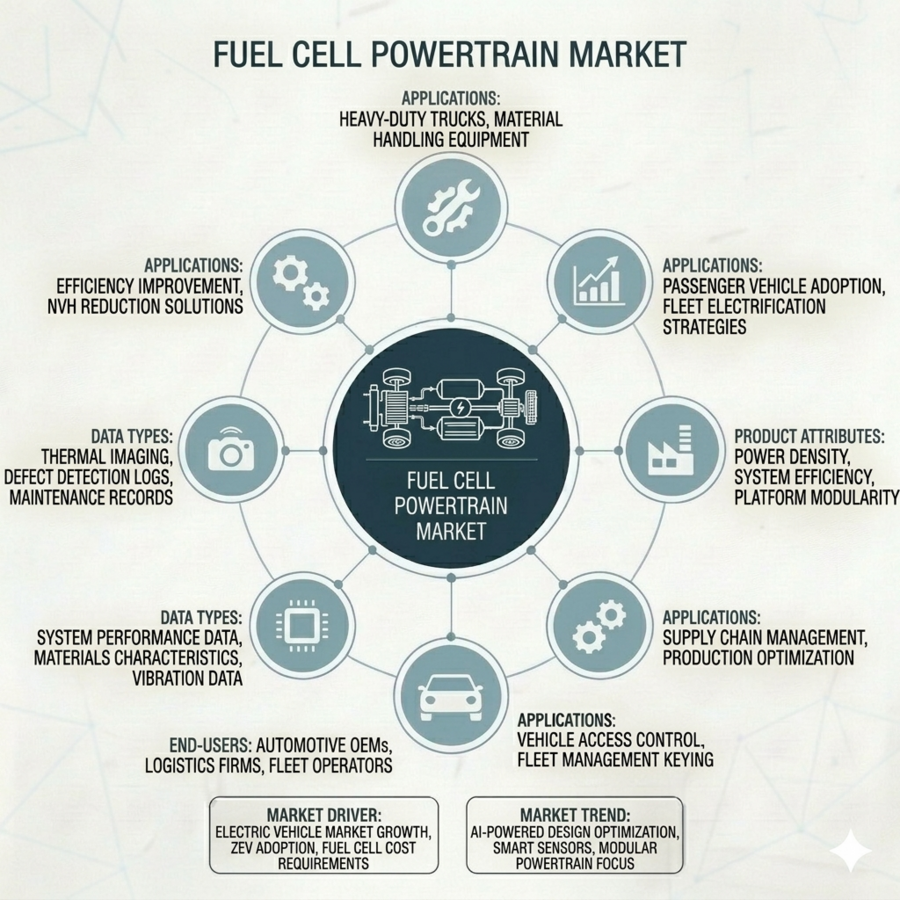
Fuel Cell Powertrain Market
Demand for fuel cell powertrains is estimated to grow to USD 1.51 billion in 2026 and USD 77.54 billion by 2036. FMI projects a CAGR of 48.3%.
NEWARK, DE, UNITED STATES, March 24, 2026 /EINPresswire.com/ -- The global automotive industry is witnessing a massive transition toward high-utilization, zero-emission heavy-duty transport. According to the latest analysis by Future Market Insights (FMI), the Global Fuel Cell Powertrain Market was valued at USD 1.02 billion in 2025 and is estimated to reach USD 1.51 billion in 2026. Propelled by an aggressive CAGR of 48.3%, the market is forecast to skyrocket to USD 77.54 billion by 2036.
This explosive growth represents an absolute dollar expansion of USD 76.03 billion over the decade. While the market is scaling up from a relatively low base, the shift is being driven by the limitations of battery-only solutions in long-haul, heavy-payload applications. As Akio Toyoda, Chairman of Toyota Motor Corporation, recently highlighted, global partnerships—such as the expanded collaboration between Toyota and BMW—are essential to creating a "better future for mobility society" through shared hydrogen passion and belief.
Get Access of Report Sample:
https://www.futuremarketinsights.com/reports/sample/rep-gb-26219
The Heavy-Duty Pivot: Why Fuel Cells Lead in Logistics
The fundamental driver for fuel cell adoption is the "Uptime Economy." For long-haul trucks and municipal buses, the weight penalty of massive batteries and the hours required for recharging are often operationally non-viable.
Key Market Insights for 2026:
• Commercial Dominance (87% Share): Commercial trucks and buses hold the vast majority of the market. These fleets prioritize the fast refueling and sustained range that hydrogen provides, particularly in depot-based operations where infrastructure is controllable.
• Integrated Modules (34% Share): The Fuel Cell Module (Stack + Balance of Plant) remains the primary value gate. Procurement is shifting toward "packaged" integration where a single vendor provides the stack, air handling, and thermal systems, ensuring accountability and simplified servicing.
• Refueling Density: The adoption curve is strictly gated by the "Hydrogen Hub" model. Growth is currently clustering around industrial ports, logistics corridors, and regions supported by the EU’s Alternative Fuels Infrastructure Regulation (AFIR) targets.
Regional Growth Engines: China and India Leading the Charge
The geography of the fuel cell market is defined by aggressive public procurement and state-led infrastructure missions.
China leads the global landscape with a projected 65.2% CAGR. This growth is fueled by city-cluster deployment programs that link incentives to actual operating mileage and local manufacturing content. India follows closely with a 60.4% CAGR, supported by the National Green Hydrogen Mission, which is fostering confidence in downstream mobility pilots and industrial supply chains.
In the West, growth is corridor-led. Germany (55.5% CAGR) and France (50.7% CAGR) are benefiting from the rollout of high-capacity refueling stations along the TEN-T transport network. In the United States (41.1% CAGR), demand is concentrated in California’s drayage routes and federally funded regional hydrogen hubs, where the Department of Energy is actively de-risking the economics of fleet transitions.
Competitive Landscape: The Integration Advantage
Competition is intensifying between legacy automotive OEMs and specialist hydrogen technology firms. The market is favoring players who can prove "field-hardened" durability and provide a comprehensive service network.
• Strategic Ecosystems: Toyota and BMW are leveraging cross-platform learning to shorten development cycles. Hyundai Motor Company continues to lead in mass-produced fuel cell heavy-duty platforms.
• Integrated Supply: Ballard Power Systems and Plug Power are securing multi-year frame agreements, such as Plug Power's recent deal with STEF in Europe, which integrates vehicle supply with hydrogen refueling logistics.
• Industrial Scale: Cummins (Accelera) and Bosch are standardizing interfaces across stacks and power electronics to allow for rapid scaling across different vehicle classes.
Key Players in the Fuel Cell Powertrain Market:
• Toyota Motor Corporation
• Hyundai Motor Company
• Ballard Power Systems
• Plug Power Inc.
• Cummins Inc.
• Symbio (Faurecia & Michelin JV)
• Bosch Hydrogen Powertrain Systems
• AVL List GmbH
• Horizon Fuel Cell Technologies
Executive Takeaways: The Path to 2036
For fleet operators and manufacturers, the next decade requires a focus on "Infrastructure Sequencing."
1. Prioritize Corridors: Early adoption must be linked to hydrogen hubs to ensure fuel availability and price visibility.
2. Service Readiness: Field technicians and remote diagnostic capabilities are now mandatory parts of the powertrain offer to guarantee vehicle uptime.
3. Standardization: Shortening platform engineering cycles through standardized interfaces between the stack, storage, and electric drive units (EDU) will be the primary lever for cost reduction.
Frequently Asked Questions (FAQ)
1. How does a fuel cell powertrain work compared to a battery EV?
While both use electric motors to drive the wheels, a battery EV stores energy in a large battery pack charged from the grid. A fuel cell vehicle generates its own electricity onboard by combining stored hydrogen with oxygen from the air, emitting only water vapor.
2. Why is hydrogen better for heavy trucks?
Weight and time. To get a 500-mile range, a battery truck requires several tons of batteries, which reduces the amount of cargo it can carry. A hydrogen truck is much lighter and can be refueled in 15–20 minutes, similar to a diesel truck.
3. What is "Balance of Plant" (BoP)?
The BoP includes all the supporting components of the fuel cell stack, such as the air compressor, cooling pumps, and hydrogen recirculators. These are critical for maintaining the right temperature and pressure for the fuel cell to operate efficiently.
4. Is hydrogen fuel expensive?
Currently, yes. However, as "Green Hydrogen" production scales and corridor infrastructure matures, the total cost of ownership (TCO) is expected to reach parity with diesel by the early 2030s, especially when factoring in carbon taxes and zero-emission incentives.
Brows More Industry Reports
Fuel Cell Market
https://www.futuremarketinsights.com/reports/global-fuel-cell-market
Fuel Cell UAV Market
https://www.futuremarketinsights.com/reports/fuel-cell-uav-market
Fuel Cell Stack Market
https://www.futuremarketinsights.com/reports/fuel-cell-stack-market
Sudip Saha
Future Market Insights Inc.
+1 347-918-3531
email us here
Legal Disclaimer:
EIN Presswire provides this news content "as is" without warranty of any kind. We do not accept any responsibility or liability for the accuracy, content, images, videos, licenses, completeness, legality, or reliability of the information contained in this article. If you have any complaints or copyright issues related to this article, kindly contact the author above.
