

Electrifying Growth: Global Battery Management System Market to Power USD 23.3 Billion Value by 2035
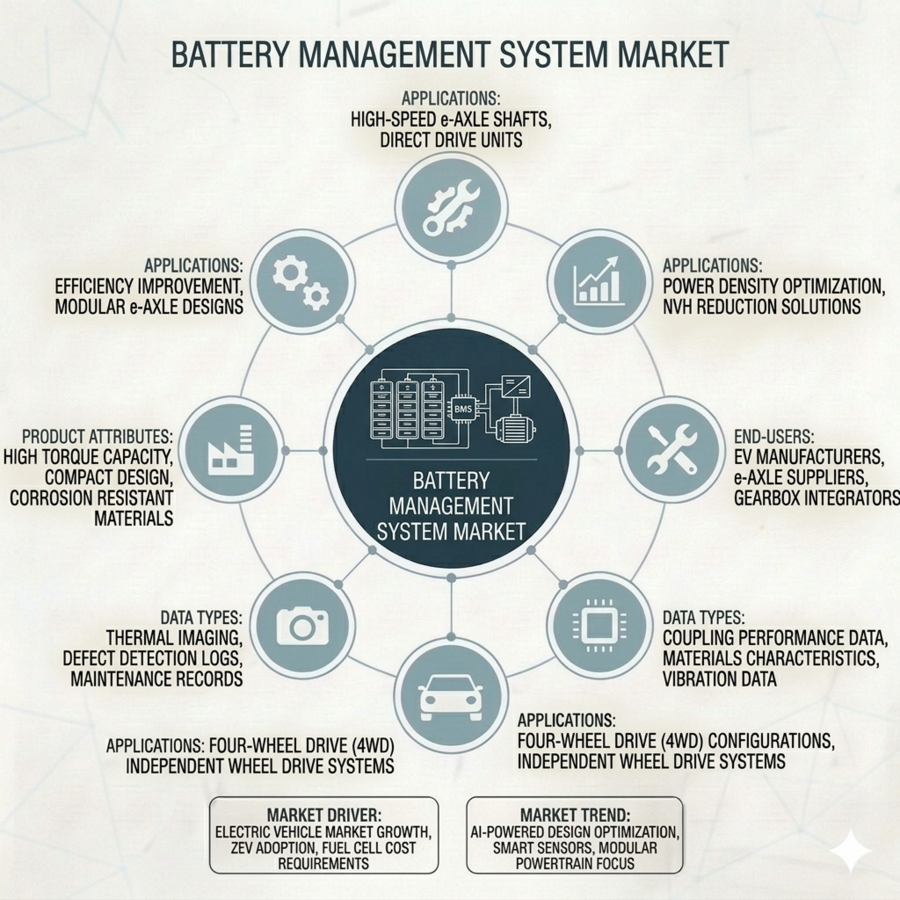
Battery Management System Market
The global sales of battery management systems are estimated to be worth USD 10.2 billion in 2025, and are anticipated to reach USD 23.3 billion by 2035.
NEWARK, DE, UNITED STATES, March 24, 2026 /EINPresswire.com/ -- The global transition toward a high-voltage, software-defined future is accelerating the demand for sophisticated energy governance. According to the latest strategic study by Future Market Insights (FMI), the Global Battery Management System (BMS) Market was valued at USD 10.2 billion in 2025 and is projected to reach USD 23.3 billion by 2035, expanding at a compound annual growth rate (CAGR) of 8.6%.
This momentum is anchored in the "intelligence layer" of the battery pack. As vehicle OEMs and grid operators move toward larger, more complex lithium-ion systems, the BMS has evolved from a simple monitoring tool into a critical command center that utilizes AI, IoT, and digital twins to optimize safety and longevity.
The Intelligence Edge: Smart Technologies and AI Integration
The modern BMS is no longer just about measuring voltage; it is about predictive survivability. Advanced systems now integrate machine learning to refine State-of-Charge (SoC) and State-of-Health (SoH) estimations, allowing for 55% more accurate range forecasting in electric vehicles compared to 2022 standards.
Get Access of Report Sample:
https://www.futuremarketinsights.com/reports/sample/rep-gb-458
Key Market Takeaways for 2026:
• Lithium-Ion Dominance (44% Share): Driven by the surge in residential solar storage and grid-scale projects, lithium-ion-specific BMS remains the primary value segment.
• Automotive Acceleration (7.4% CAGR): The EV sector continues to be the most dynamic application, with industry leaders like Tesla, Ford, and BYD deploying next-generation BMS to maximize range and thermal safety.
• Wireless BMS Revolution: Emerging wireless solutions are eliminating extensive wiring harnesses, reducing pack weight, and simplifying manufacturing while minimizing physical failure points.
Regional Powerhouses: China’s Medical and India’s EV Boom
The geography of the BMS market is shifting toward specialized regional applications and massive infrastructure modernization.
China is set to experience a staggering 24.0% CAGR through 2035. While its EV dominance remains clear, the country has also emerged as a leading hub for battery-powered medical devices. Companies like Mindray Medical reported a 30% increase in portable device production, where sophisticated BMS is essential for patient safety in ventilators and wearable monitors.
India follows with an 11.2% CAGR, fueled by homegrown technology partnerships. A recent USD 180 million collaboration between Fasmho Energy and Cyantron Synergies to develop high-voltage battery systems for heavy-duty trucks and buses underscores the region’s push for localized, reliable energy solutions.
In the United States (8.2% CAGR), demand is increasingly driven by defense modernization. The military’s reliance on battery-powered UAVs and ground vehicles requires robust BMS capable of operating in extreme temperatures and prolonged mission environments. Meanwhile, in Germany (8.0% CAGR), the rollout of 5G networks by providers like Deutsche Telekom is necessitating high-efficiency BMS for telecom backup systems to ensure grid resilience.
Competitive Landscape: Strategic Alliances and Acquisitions
The competitive environment is consolidating as Tier 1 vendors seek "silicon-to-software" integration.
• Silicon Leaders: NXP Semiconductors, Texas Instruments, and Analog Devices are providing the automotive-grade microcontrollers that serve as the "brain" for modern battery packs.
• Strategic Partnerships: In early 2024, BMW and Rimac Technology announced a long-term partnership to co-develop high-voltage battery technologies, signaling a shift toward high-volume, high-performance Tier 1 supply chains.
• Infrastructure Synergy: Sun Mobility and IndianOil have partnered to establish one of the world's largest battery-swapping networks, emphasizing the need for standardized BMS across swapping ecosystems.
Key Players in the Battery Management System Industry:
• Texas Instruments
• NXP Semiconductors
• Analog Devices
• Robert Bosch GmbH
• Tesla (In-house)
• LG Energy Solution
• Panasonic Corporation
• Samsung SDI
• Sensata Technologies
Executive Takeaways: Overcoming Implementation Barriers
Despite the robust growth, the market faces a "Cost vs. Complexity" challenge.
1. Initial Capex: The high cost of high-accuracy sensors and DAQs remains a barrier for budget-conscious sectors.
2. Specialized Talent: The lack of cybersecurity and battery-engineering talent restricts rapid deployment of compliant infrastructures.
3. Standardization: Bridging the gap between varying communication interfaces (CAN, Modbus, SMBus) is crucial for universal energy storage integration.
Frequently Asked Questions (FAQ)
1. What is the primary function of a BMS?
A BMS ensures a battery operates within its "Safe Operating Area" by monitoring voltage, current, and temperature. It prevents dangerous conditions like overcharging, which can lead to thermal runaway (fires).
2. What is the difference between Active and Passive Balancing?
Passive balancing dissipates excess charge from stronger cells as heat to match weaker cells. Active balancing is more efficient, as it "shuttles" energy from stronger cells to weaker ones using capacitive or inductive storage, maximizing the total usable energy of the pack.
3. Why is Wireless BMS (wBMS) significant?
Traditional BMS requires miles of copper wiring inside a battery pack. wBMS uses secure wireless protocols to communicate data, reducing weight by up to 90 kg in some EVs and allowing for more flexible battery pack shapes.
4. How does AI improve battery life?
AI models analyze historical usage data to predict when a battery is likely to fail or degrade. This "Predictive Maintenance" allows operators to swap cells or adjust charging speeds before a problem occurs, potentially extending battery life by 20% to 30%.
Brows More Industry Reports
Battery Management System Market Share Analysis
https://www.futuremarketinsights.com/reports/battery-management-system-market-share-analysis
Japan Battery Management System Market
https://www.futuremarketinsights.com/reports/battery-management-system-industry-analysis-in-japan
Korea Battery Management System Market
https://www.futuremarketinsights.com/reports/battery-management-system-industry-analysis-in-korea
Sudip Saha
Future Market Insights Inc.
+1 347-918-3531
email us here
Legal Disclaimer:
EIN Presswire provides this news content "as is" without warranty of any kind. We do not accept any responsibility or liability for the accuracy, content, images, videos, licenses, completeness, legality, or reliability of the information contained in this article. If you have any complaints or copyright issues related to this article, kindly contact the author above.
