

How ATO Debt Is Forcing Australian SMEs Into Insolvency in 2026 — And What Directors Can Do

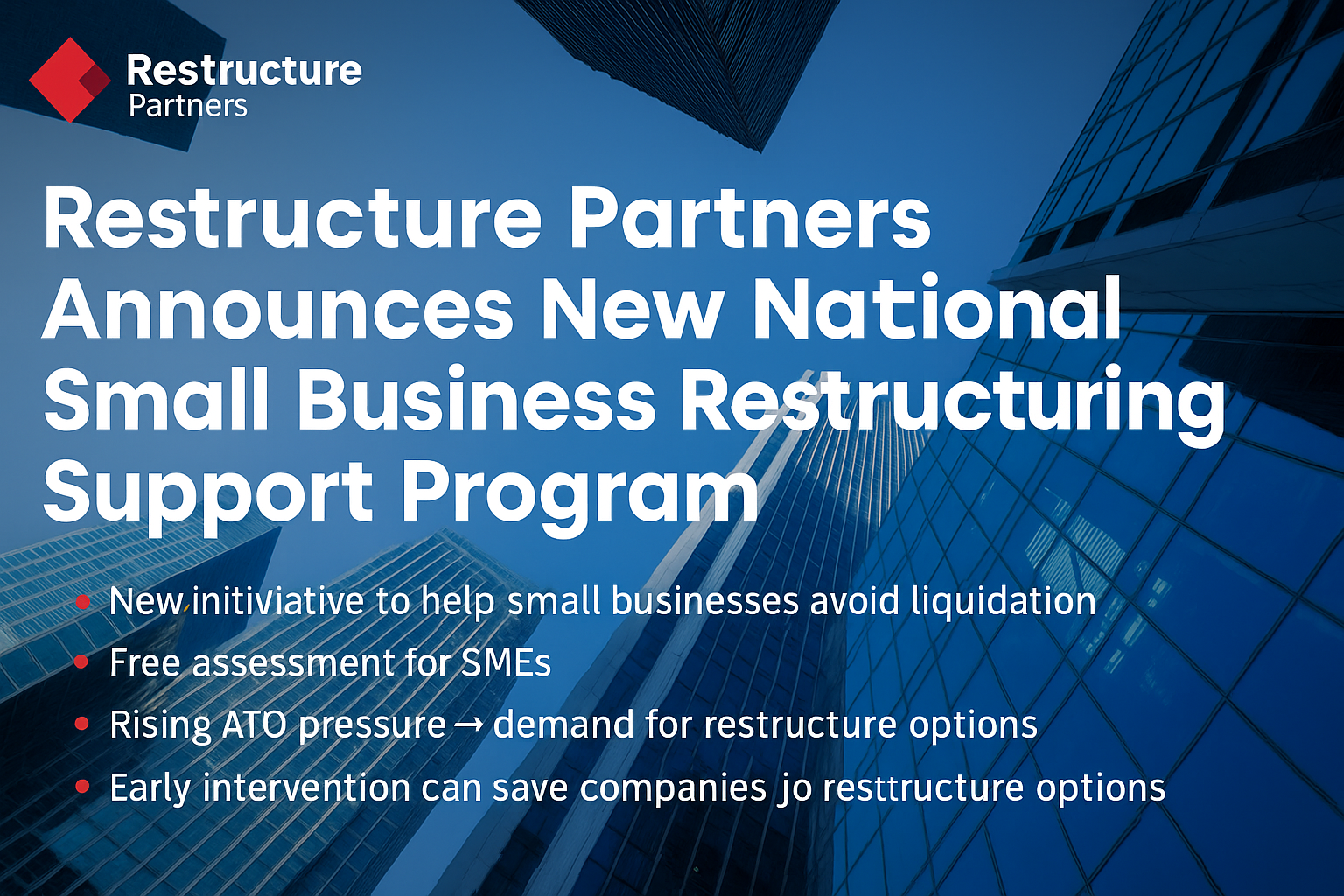
Restructure Partners
In 2026, the most common catalyst for formal insolvency action among Australian small businesses.
In 2026, the most common catalyst for formal insolvency action among Australian small businesses is not a bank calling in a loan or a landlord terminating a lease.”
SYDNEY, NSW, AUSTRALIA, April 7, 2026 /EINPresswire.com/ -- How ATO Debt Is Forcing Australian SMEs Into Insolvency in 2026 — And What Directors Can Do— Restructure Partners
FOR IMMEDIATE RELEASE
In 2026, the most common catalyst for formal insolvency action among Australian small businesses is not a bank calling in a loan or a landlord terminating a lease. It is a letter from the Australian Taxation Office — and for many directors, it arrives with little warning and significant personal consequences attached.
ATO debt has become the defining financial pressure for thousands of SMEs that are otherwise trading adequately but cannot absorb the weight of historical tax liabilities accumulated during and after the COVID-19 period. ReStructure Partners helps Australian directors navigate every stage of ATO and financial distress, from overdue BAS and tax debt through to Director Penalty Notices, restructuring solutions, voluntary administration, and broader insolvency options.
The firm's advisory work in 2025 and 2026 reflects a clear pattern: ATO debt is the primary catalyst for formal insolvency action in a majority of the distressed business situations it encounters.
How the Debt Accumulated
To understand why ATO debt is so prevalent in 2026, it is necessary to understand what happened during the COVID-19 period. Between 2020 and 2022, the ATO significantly reduced its enforcement activity to support businesses through an unprecedented period of disruption. Payment arrangements were extended, interest and penalties were remitted, and the ATO signalled that it would adopt a supportive posture rather than an adversarial one.
Many businesses deferred their tax obligations during this period — some deliberately as a cash management strategy, others because the operational challenges of the pandemic left little bandwidth for compliance. The result was a substantial accumulation of ATO debt across the economy that was never fully resolved before the forbearance period ended.
From 2023 onward, the ATO progressively tightened its approach. By 2026, the tax office's enforcement posture is, by its own description, fully normalised. Directors who assumed ongoing leniency are now discovering that assumption was incorrect.
Directors seeking specific guidance on managing ATO arrears can access information on ATO debt help at https://restructurepartners.com.au/ato-debt-help.
The Personal Liability Dimension
What makes ATO debt particularly serious for directors — as distinct from other forms of business debt — is the potential for personal liability through the Director Penalty Notice regime.
A DPN is a formal notice that makes a director personally responsible for certain company tax obligations, including PAYG withholding and superannuation guarantee charge. The nature of the notice — lockdown or non-lockdown — determines what options remain available.
A non-lockdown DPN can be addressed by the director taking qualifying action within 21 days, such as placing the company into voluntary administration or small business restructuring. A lockdown DPN, however, attaches personal liability permanently. It cannot be discharged by subsequent corporate action, regardless of what happens to the company.
Lockdown DPNs arise where relevant obligations were not reported to the ATO within three months of the due date. Directors who were unaware of their lodgement obligations during the pandemic, or whose compliance was not properly managed, may carry personal liability for company tax debts that cannot be escaped.
Further detail on Director Penalty Notice exposure and response options is available at https://restructurepartners.com.au/director-penalty-notice.
What Directors Can Do Right Now
For directors carrying ATO debt in 2026, the appropriate response depends on the specifics of their situation. Options that may be available — depending on the circumstances — include:
- Engaging the ATO to establish or renegotiate a payment arrangement
- Seeking remission of penalties and interest through a formal objection process
- Commencing a small business restructuring process to address ATO and other debts comprehensively
- Appointing a voluntary administrator to manage a broader creditor resolution
What is universally true is that delay makes the situation worse. ATO debt grows through the accumulation of general interest charge, which compounds the underlying liability continuously. Directors who act promptly may be in a position to contain the damage; those who wait will typically face a materially larger problem.
The firm's advisory team works with directors across all of these scenarios to identify which approach may be most appropriate given their specific circumstances.
ReStructure Partners works with Australian directors and business owners experiencing financial pressure, including ATO debt, cash flow issues, and creditor stress. The firm provides support across the full spectrum of financial distress, from early-stage tax arrears and compliance issues through to Director Penalty Notices, small business restructuring, voluntary administration, and other insolvency pathways, depending on the circumstances.
Contact:
ReStructure Partners
https://restructurepartners.com.au
###
Restructure Partners
Restructure Partners
+61 468 061 936
email us here
Legal Disclaimer:
EIN Presswire provides this news content "as is" without warranty of any kind. We do not accept any responsibility or liability for the accuracy, content, images, videos, licenses, completeness, legality, or reliability of the information contained in this article. If you have any complaints or copyright issues related to this article, kindly contact the author above.
