

Light-based digital memory moves photonic computing toward gigabit-scale storage
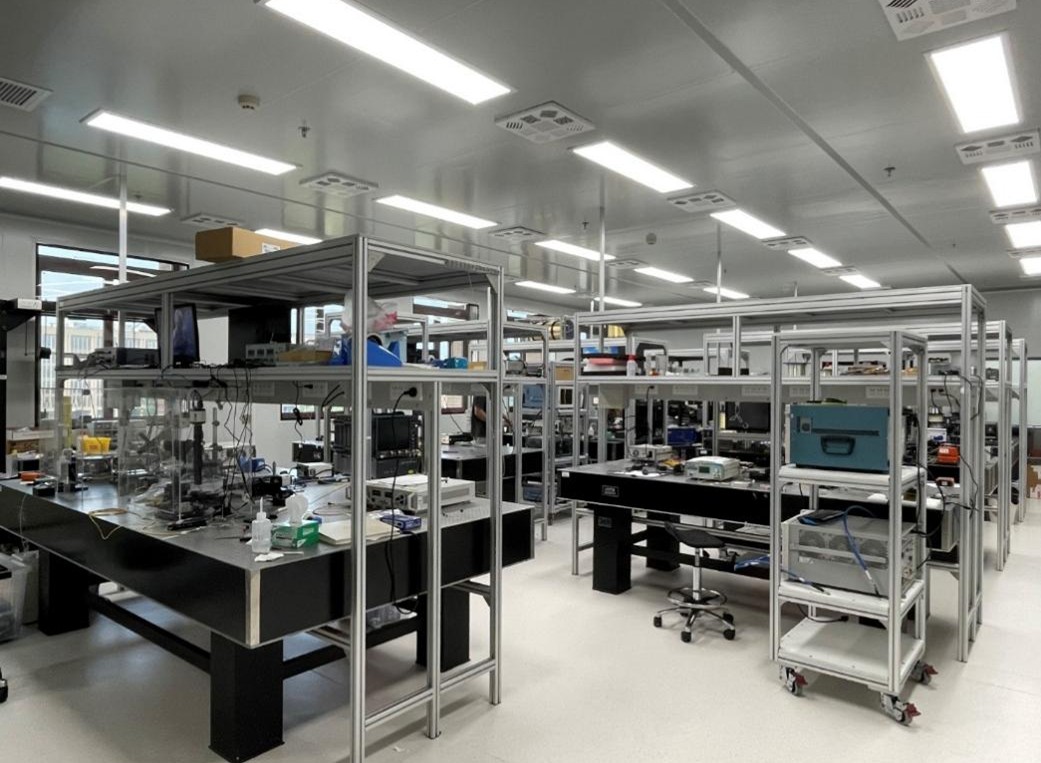
Researchers at the Microwave Photonics Research Laboratory at Jinan University, where work on Raman-amplified optical memory and photonic computing is conducted.
Optical computing is attracting strong interest because light can carry and process information at extremely high speed while consuming less energy than many electronic approaches. In principle, optical systems can accelerate demanding tasks such as artificial intelligence inference, image processing, scientific simulation, and high-bandwidth signal processing. However, most proposed optical processors still depend on electronic memory to hold intermediate data. Each time information is converted between light and electronics, the system pays a penalty in speed, energy, and complexity.
This storage bottleneck has made it difficult to build a truly scalable architecture in which data can be computed, stored, and transferred entirely in the optical domain. Existing optical buffering methods can delay signals for a short time, but they often suffer from limited capacity, accumulated noise, and unstable gain when a signal circulates repeatedly. These challenges become especially serious for digital information, where many amplitude levels must be preserved accurately enough for the original data to be recovered.
The study addresses this missing link by exploring an all-optical digital memory that can keep data in light for many circulation cycles. Instead of using conventional erbium-doped fiber amplification, the authors use distributed Raman amplification inside a frequency-shifting loop. This approach provides low-noise, broadband gain and supports wavelength-division multiplexing, which means that multiple data streams can be stored in parallel on different optical carriers.
Section 2: Key Contributions of the Paper
The research team led by Prof. Jiejun Zhang at Jinan University and Prof. Jianping Yao at the University of Ottawa proposed and experimentally demonstrated a distributed Raman-amplified optical memory for digital signal storage. The study was made available online on June 3, 2026, and published in Volume 2 of the journal Intelligent Opto-Electronics on June 29, 2026. The core of the system is a frequency-shifting loop in which the optical signal repeatedly circulates through a dispersion-shifted fiber that also serves as the Raman gain medium. Because the amplification is distributed along the fiber rather than concentrated at a single amplifier, the loop can compensate loss while introducing less noise and smaller waveform distortion.
In the proof-of-concept experiment, a grayscale image was encoded as a PAM-256 digital waveform and injected into the optical loop. The team stored a 3.2-Mbit digital frame, including a synchronization flag, and showed that the signal remained detectable after more than 200 circulations, corresponding to a storage duration longer than 20 ms. Reconstructed images stayed visually faithful during the early circulation cycles, and the paper quantitatively tracked storage fidelity using root mean square error and effective number of bits. These measurements provide a clear bridge between optical waveform quality and recoverable digital information.
A second important contribution is the demonstration of multi-wavelength storage. The red, green, and blue channels of a color image were converted into separate PAM-256 signals and carried by three optical wavelengths. After wavelength-division multiplexing, the three channels circulated together in the same loop and were later demodulated to reconstruct the color image. This result directly illustrates how the wide gain bandwidth of the Raman amplifier can be used to expand optical memory capacity through parallel wavelength channels.
The demonstrated experiment used three wavelength channels and achieved an effective storage capacity of approximately 3.2 Mbit under the available instrument bandwidth. More importantly, the analysis shows a path toward much larger capacity. With the more than 40-nm flat Raman gain bandwidth around 1550 nm, up to 40 wavelength channels could be supported at 125-GHz spacing. At a 60-GSa/s sampling rate, the authors estimate that the total theoretical storage capacity could reach 3.84 Gbit. This makes the work a meaningful step toward optical cache modules for future large-scale photonic computing pipelines.
Section 3: Overview of the Authors' Research Group
This work was carried out by researchers from the Microwave Photonics Group at Jinan University, together with the Microwave Photonics Research Laboratory at the University of Ottawa. The Jinan University team focuses on microwave photonics, photonics integration, and optical communications. The University of Ottawa team has longstanding expertise in microwave photonics, optical arbitrary waveform generation, optical signal storage, and photonic processing architectures.
Reference
Title of original paper: Towards Gigabit-scale digital signal storage enabled by a distributed Raman-amplified optical memory
Journal: Intelligent Opto-Electronics
DOI: http://doi.org/10.67704/ioe.2026.260008
Siyi Ma
Institute of Optics and Electronics, Chinese Academy of Scie
+86 19136186296
email us here
Legal Disclaimer:
EIN Presswire provides this news content "as is" without warranty of any kind. We do not accept any responsibility or liability for the accuracy, content, images, videos, licenses, completeness, legality, or reliability of the information contained in this article. If you have any complaints or copyright issues related to this article, kindly contact the author above.
