

India Pre-engineered Buildings Market at 9.4% CAGR to Grow from USD 15.26 Billion in 2026 to USD 34.25 Billion by 2035
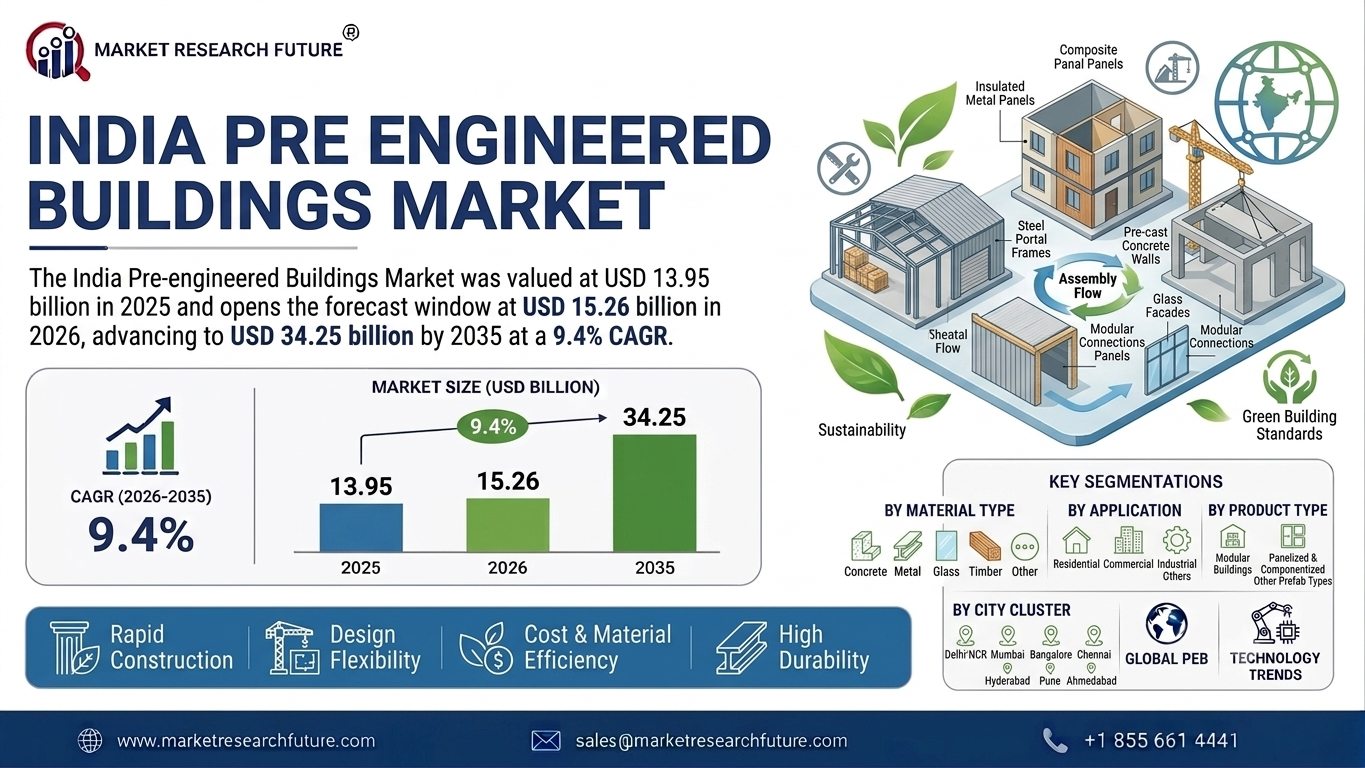
India Pre Engineered Buildings Market (2025 - 2035)
Bengaluru is forecast to grow at a 10.6% CAGR, the highest among metro clusters tracked in the India Pre-engineered Buildings Market
BENGALURU, INDIA, September 7, 2026 /EINPresswire.com/ -- The India Pre-Engineered Buildings Market is moving rapidly from a specialized construction solution toward a mainstream building-delivery model as developers, manufacturers, logistics operators, and infrastructure companies seek faster project completion, controlled costs, and greater construction efficiency. According to the latest Market Research Future analysis, the market was valued at USD 13.95 billion in 2025 and is projected to increase from USD 15.26 billion in 2026 to USD 34.25 billion by 2035, expanding at a 9.4% CAGR between 2026 and 2035.The market is being supported by affordable housing programs, logistics and warehousing expansion, data-center investments, manufacturing capacity additions, energy-efficiency requirements, and increasing adoption of factory-controlled construction. These factors are changing how buildings are designed, manufactured, transported, and assembled across India.
India Pre-Engineered Buildings Market Growth Drivers
One of the strongest growth catalysts is India's continued urbanization and infrastructure development. Developers increasingly need construction methods that can deliver usable buildings within shorter project schedules while maintaining consistent quality.
Government-backed affordable housing programs are also expanding the addressable market for factory-produced structural and building components. PMAY-Urban 2.0, for example, provides substantial central assistance for urban housing and includes support for innovative construction technologies. This creates opportunities for factory-made wall, roof, and structural systems in large housing programs.
The expansion of logistics infrastructure is another major driver. India's growing e-commerce sector requires warehouses and distribution centers that can be developed quickly and scaled efficiently. Pre-engineered structures are well suited to these facilities because they can provide large clear-span areas and accommodate changing storage configurations.
Warehousing and Logistics Create New Demand
The rapid development of Grade-A warehousing is becoming an important source of demand for pre-engineered buildings.
Modern warehouses require large column-free spaces for automated storage, pallet racking, material handling, and fulfillment operations. Steel-framed pre-engineered structures can provide these large spans while reducing construction timelines compared with conventional site-intensive approaches.
The expansion of multimodal logistics parks under initiatives such as PM Gati Shakti is adding another layer of demand. Projects with compressed handover schedules favor suppliers capable of fabricating structural components in controlled factory environments and assembling them rapidly at the project site.
As e-commerce, third-party logistics, organized retail, and manufacturing supply chains expand, demand for warehouses and distribution facilities is expected to remain a major growth engine through 2035.
Get Report Free Sample Copy: https://www.marketresearchfuture.com/sample_request/2565
Data Centers Strengthen the Market
India's rapidly expanding data-center industry is creating another high-value opportunity for pre-engineered building suppliers.
Data centers require buildings to be completed quickly because delays in shell delivery can postpone expensive equipment installation and revenue generation. Factory-produced building envelopes can help shorten construction schedules while maintaining tighter quality control.
Major data-center activity is concentrated around Mumbai, Navi Mumbai, Chennai, Hyderabad, Bengaluru, and other major technology hubs. The current MRFR report highlights data-center and hyperscale capacity as one of the important drivers of India's pre-engineered building market.
The opportunity extends beyond conventional steel structures. Mission-critical facilities require carefully engineered envelopes, thermal performance, dimensional accuracy, and integration with sophisticated mechanical and electrical systems.
Manufacturing Sector Remains a Key End User
Manufacturing continues to represent a significant application area for pre-engineered buildings because factories frequently need additional production space without lengthy construction interruptions.
Industrial facilities can use pre-engineered structures for production halls, warehouses, assembly areas, maintenance buildings, and auxiliary facilities. Their modular nature allows manufacturers to expand or modify facilities as production requirements change.
India's push toward domestic manufacturing and industrial investment is likely to create additional demand. Electronics, pharmaceuticals, automotive components, engineering products, and other manufacturing sectors increasingly require facilities that can be delivered within aggressive project schedules.
The expansion of production-linked investment programs is also creating opportunities for specialized industrial buildings.
Residential Construction Gains Importance
Residential applications represented 48.5% of market demand in 2025, making residential construction an important segment of the India Pre-Engineered Buildings Market.
Affordable housing programs, urban population growth, and the need for faster construction are encouraging developers to explore prefabricated and factory-controlled building solutions.
Factory manufacturing can improve consistency and reduce dependence on highly variable site conditions. It can also help address labor shortages by shifting a greater proportion of construction activity into controlled production environments.
As India's smaller cities and peripheral urban areas continue to develop, prefabricated construction can become increasingly relevant for residential projects where developers need predictable delivery schedules.
Commercial Construction Represents a Fast-Growing Opportunity
Commercial construction is projected to expand at a 9.9% CAGR through 2035, supported by data centers, retail warehouses, commercial facilities, and other institutional and business infrastructure.
Commercial developers place considerable emphasis on project timelines because delayed building completion can postpone tenant occupancy and revenue generation.
Pre-engineered construction offers advantages through factory fabrication, standardized components, faster site erection, and reduced dependence on prolonged on-site fabrication.
The growing adoption of BIM and digital project management is further improving coordination between designers, manufacturers, contractors, and building owners.
Materials and Technology Trends
The market incorporates multiple material categories, including concrete, metal, glass, timber, and other materials. Concrete accounted for 38.1% of the market in 2025, while metal systems generated approximately USD 3.68 billion in revenue.
Metal systems remain particularly important for industrial and logistics applications because of their strength-to-weight characteristics, flexibility, and suitability for large-span structures.
At the same time, timber is emerging as a high-growth material category, projected to expand at a 10.4% CAGR through 2035. Growing interest in low-embodied-carbon construction and sustainable building materials is encouraging developers to evaluate timber-based solutions for selected applications.
Automation is also becoming increasingly important. Automated roll-forming, CNC fabrication, BIM-driven production, and digitally controlled manufacturing can improve precision while reducing fabrication waste.
Modular Construction Accelerates Adoption
Modular construction is becoming an increasingly important component of India's pre-engineered building ecosystem.
Factory production allows multiple building components to be manufactured simultaneously while site preparation occurs in parallel. This can compress overall project schedules compared with sequential conventional construction.
Hybrid approaches are also gaining attention because they combine factory-produced elements with conventional construction methods. This allows developers to select the most suitable approach according to project requirements, location, structural system, and budget.
As construction companies become more experienced with off-site production, integration between design software and factory machinery is expected to improve further.
Skilled Labor Shortages Support Factory-Based Construction
India's construction industry continues to face challenges related to the availability of skilled workers in welding, fabrication, formwork, finishing, and other specialized activities.
Pre-engineered construction addresses part of this challenge by transferring labor-intensive processes from unpredictable construction sites into controlled manufacturing facilities.
The MRFR report identifies skilled site labor scarcity as a meaningful driver of adoption. Factory-based production can allow fewer workers to achieve higher productivity while improving process standardization.
This advantage becomes particularly important in metropolitan areas where construction wages and project delays can increase overall development costs.
Regional Outlook
South India
South India accounted for 30.2% of national market value in 2025, making it India's leading regional market. Bengaluru's data-center and electronics ecosystem and Chennai's automotive and industrial activity are important contributors to regional demand.
The region's established manufacturing base, technology infrastructure, industrial corridors, and logistics networks provide favorable conditions for pre-engineered building adoption.
East and Northeast India
East and Northeast India represents the fastest-growing regional zone, with a projected 10.8% CAGR through 2035. Industrial corridors, port-linked development, infrastructure investment, and emerging manufacturing activity are supporting regional expansion.
As infrastructure connectivity improves, demand for warehouses, industrial buildings, institutional facilities, and commercial structures is expected to increase.
West India
West India, particularly Maharashtra and Gujarat, is another major market because of its strong manufacturing and logistics ecosystem.
The region has significant warehouse absorption, industrial development, port connectivity, and access to major consumption centers. Mumbai, Pune, Ahmedabad, and surrounding industrial clusters therefore represent important opportunities for pre-engineered building suppliers.
Metro and Emerging City Clusters
Bengaluru is projected to record a 10.6% CAGR, the highest growth rate among the metro clusters tracked in the current report.
Beyond India's largest cities, Tier-2 and Tier-3 locations are becoming increasingly attractive. Developers in cities such as Coimbatore, Indore, Lucknow, Bhubaneswar, and Surat require construction solutions that can address limited skilled-labor availability and growing demand for industrial, residential, and commercial infrastructure.
Key Challenges
Despite strong growth prospects, the India Pre-Engineered Buildings Market faces several challenges.
Transportation and route permitting can affect project economics, particularly for oversized structural components and volumetric modules. State-level permissions and road restrictions can introduce delays and increase logistics costs.
Another challenge is the shortage of certified fabrication and design professionals. Welding, BIM detailing, roll-forming, and other specialized skills require training and experience.
Steel and cement price volatility can also create uncertainty for contractors operating under fixed-price agreements. Significant changes in raw-material costs can reduce margins and make project pricing more difficult.
Fragmentation in municipal building codes and approval procedures represents another obstacle. Greater standardization and clearer acceptance of factory-produced construction systems could reduce approval timelines.
Buy Now: https://www.marketresearchfuture.com/checkout?currency=one_user-USD&report_id=2565
Opportunities in Tier-2 and Tier-3 Cities
The expansion of pre-engineered buildings beyond India's major metropolitan areas represents a substantial long-term opportunity.
A large share of future urban housing and infrastructure demand is expected to emerge outside the country's largest cities. These locations often have limited skilled labor availability, making factory-based construction particularly attractive.
Establishing regional manufacturing or fabrication facilities could help suppliers reduce transportation distances and improve response times.
Satellite plants located close to emerging industrial clusters can also enable companies to serve local customers more efficiently while reducing the economic disadvantages associated with transporting large structural components over long distances.
Digitalization and Smart Construction
Digital technologies are becoming increasingly important across the pre-engineered building value chain.
Building Information Modeling (BIM) allows designers, fabricators, contractors, and owners to work from coordinated digital models. BIM-to-factory workflows can reduce errors, improve material planning, and accelerate production.
Digital twins and building-performance monitoring can create additional opportunities after construction. Manufacturers could potentially provide ongoing services related to envelope performance, maintenance, component replacement, and warranty management.
This creates a pathway for manufacturers to evolve from product suppliers into long-term building technology and service providers.
Sustainability Creates New Opportunities
Sustainability is becoming increasingly important in India's construction industry.
Green-building certifications and embodied-carbon reporting are encouraging developers to evaluate the environmental footprint of building materials and construction processes.
Factory-controlled production can help reduce material waste and improve resource efficiency. High-recycled-content steel, lower-carbon concrete systems, timber, and energy-efficient envelope solutions can further strengthen the sustainability proposition.
The development of Environmental Product Declarations can also provide manufacturers with independently verified information about the environmental impact of their products, helping them compete for sustainability-focused projects.
Report Summary: https://www.marketresearchfuture.com/reports/india-pre-engineered-buildings-market-2565
Competitive Landscape
The India Pre-Engineered Buildings Market includes established domestic manufacturers as well as international construction and steel companies.
Major companies identified in the current MRFR report include Tata BlueScope Steel, Kirby Building Systems India, Interarch Building Products, EPACK Prefab Technologies, Pennar Industries, and Everest Industries.
Competition is increasingly focused on manufacturing capacity, project execution, engineering capabilities, geographic coverage, digital design, material efficiency, and the ability to meet increasingly demanding delivery schedules.
Companies are also expanding into specialized applications such as logistics facilities, data centers, advanced manufacturing plants, healthcare infrastructure, and sustainable buildings.
Similar Report
Pre-Engineered Buildings Market https://www.marketresearchfuture.com/reports/pre-engineered-buildings-market-1304
prefabricated glass block market https://www.marketresearchfuture.com/reports/prefabricated-glass-block-market-36852
prefabricated steel market https://www.marketresearchfuture.com/reports/prefabricated-steel-market-25811
pre engineered metal building market https://www.marketresearchfuture.com/reports/pre-engineered-metal-building-market-31076
Engineered Fluids Market https://www.marketresearchfuture.com/reports/engineered-fluids-fluorinated-oils-market-7803
engineered stone market https://www.marketresearchfuture.com/reports/engineered-stone-market-28434
Precast Concrete Market https://www.marketresearchfuture.com/reports/precast-concrete-market-4850
Market Research Future
Market Research Future
+1 855-661-4441
email us here
Legal Disclaimer:
EIN Presswire provides this news content "as is" without warranty of any kind. We do not accept any responsibility or liability for the accuracy, content, images, videos, licenses, completeness, legality, or reliability of the information contained in this article. If you have any complaints or copyright issues related to this article, kindly contact the author above.
